On this page
Why AI-written ad scripts sound fake
If you have ever pasted a product description into a language model and asked for a video script, you know the result: “Introducing the revolutionary new bottle that will transform your hydration journey.” No person has ever said that out loud to a friend. The script reads like marketing copy because the model was trained on a lot of marketing copy.
The problem is not that AI can’t write. It is that written language and spoken language are different. Written copy uses long sentences, abstract nouns and polished transitions. Spoken ads, especially AI UGC ads and other UGC-style ones that perform on TikTok and Reels, use fragments, concrete details and the slightly messy rhythm of someone thinking while they talk.
A second cause is vagueness. Generic prompts produce generic scripts. “Write a script for a water bottle” gives you the average of every water bottle ad. A prompt that includes who the viewer is, what annoyed them, one real detail about the product and the one thing you want them to do next produces something far more specific, and specific is what sounds believable.
Third, AI loves superlatives. “Amazing,” “game-changing,” “incredible.” Real people reach for details instead: “it keeps ice for the whole workday,” “the lid doesn’t leak in my bag.” Strip the adjectives, keep the facts.
Spoken-language rules for scripts
Before choosing a framework, fix the language. These rules apply whether a human or an AI wrote the first draft, and they are the fastest way to make a script sound like a person.
Read every line out loud at normal speaking pace. If you stumble, run out of breath, or feel silly saying it, the viewer will notice too. Rewrite until you can say the whole script in one natural take.
- Short sentences. Aim for under 12 words on average, with some as short as two or three.
- Contractions everywhere: it’s, I’ve, don’t. Nobody says “it is” in casual speech.
- Concrete over abstract: “fits under my airplane seat” beats “perfect for travel.”
- One idea per sentence. If you need a semicolon, split it.
- Use second person (“you”) sparingly and first person (“I”) honestly. Don’t imply a personal experience that isn’t true.
- Cut filler openers like “Are you tired of…” unless you can name something painfully specific.
- Allow fragments. “Zero leaks. Not one.” is fine.
- Avoid brand-speak: seamless, elevated, revolutionary, solution, journey.
The 3-beat framework: the fast default
For videos under about 20 seconds, three beats are enough. The structure is Hook, Proof, Push. It keeps you from rambling, which is the main failure mode of short ads. It is the same structure we use in our workflow for making product video ads from one photo.
Hook (first 2–3 seconds): a specific problem, claim or visual that makes the right viewer stop. Proof (middle): show the product doing the thing, one or two concrete details or one honest caveat. Push (last 3–4 seconds): one clear action, tied to an offer or reason to act now.
Keep each beat to one idea. The temptation is to squeeze in five features. Resist it. A short ad that makes one point clearly beats one that makes five points forgettably.
3-beat script: skincare (about 18 seconds)
- HOOK: “My moisturizer used to pill every time I put sunscreen over it.”
- PROOF: “This one sinks in in about a minute. I put SPF on right after, and it just sits there. No little crumbs. It’s lightweight, though, so if your skin’s really dry you might want a heavier one at night.”
- PUSH: “It’s on sale this week. Link’s below.”
- ON SCREEN: close-up of application, side-by-side layering shot, price tag or offer end card.
The 5-beat framework: for 25–45 seconds
When you have more room, add depth without losing momentum. Five beats work well for demos, comparisons and anything that needs a bit of explanation: Hook, Problem, Product, Proof, Call to action.
Hook: stop the scroll with a specific line. Problem: make the viewer feel the annoyance in one or two sentences. Product: introduce it briefly and show it right away. Proof: demonstrate, give a detail, include a believable caveat. Call to action: say what to do and why now.
Notice that the product doesn’t appear until about beat three. That is deliberate. Viewers tune out to an ad that begins with a brand name, but they stay for a problem they recognize. By the time the product appears, they already care about the problem it solves.
Timing roughly works out like this for a 30-second video: hook 3 seconds, problem 6, product 6, proof 10, call to action 5. Don’t treat it as a formula. Let the demo run as long as it is interesting and cut it when it isn’t.
- Hook (0–3s): specific problem, claim or surprising visual.
- Problem (3–9s): the annoyance in the viewer’s own words.
- Product (9–15s): what it is, shown on screen, one sentence.
- Proof (15–25s): demo, detail, honest caveat.
- Call to action (25–30s): one action, one reason.
Niche examples: gadgets, apparel and a note on skincare
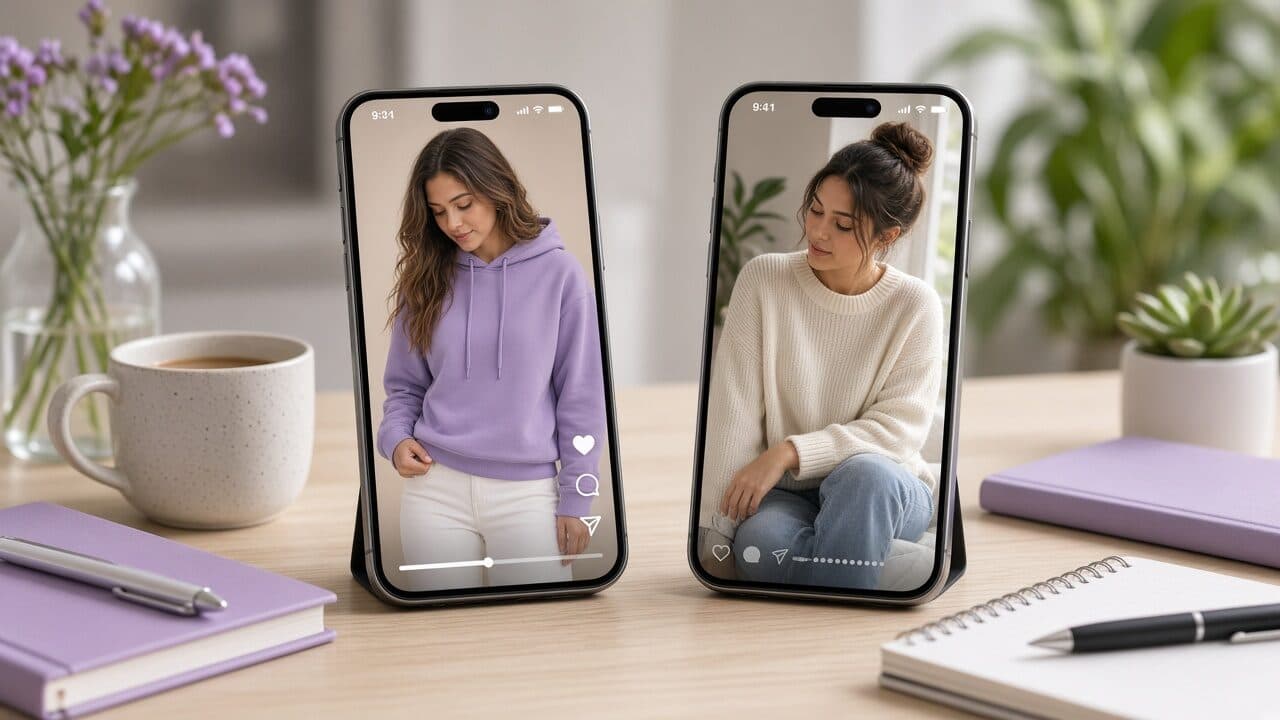
The frameworks stay the same across categories, but what counts as convincing proof changes. Gadgets need a visible demonstration and a number you can back up. Apparel needs fit, fabric and movement. Skincare needs restraint, because it is the category where overclaiming gets ads rejected and trust destroyed.
For skincare, focus on sensory and routine details (texture, absorption, how it layers) rather than outcomes you can’t substantiate. Avoid language that implies treating a medical condition. The earlier moisturizer script works because it describes an experience of using the product, not a promise about anyone’s skin.
Below are 5-beat sketches for a gadget and a piece of apparel. Treat them as shapes to borrow, not copy to paste. Swap in your real product details.
5-beat sketches: gadget and apparel
- GADGET (portable fan, ~30s)
- HOOK: “This fan is smaller than my phone and I’m not kidding about the airflow.”
- PROBLEM: “Commuting in summer means a sweaty train and a dead-battery phone.”
- PRODUCT: “It clips on my bag strap and charges over USB-C.” (show clip-on, charging)
- PROOF: “Three speeds. Lowest one ran my whole commute and I still had battery. Fair warning, top speed is loud.”
- CTA: “If you commute in the heat, link’s below.”
- APPAREL (pull-on cargo pants, ~30s)
- HOOK: “Pants with real pockets that don’t make me look like I’m smuggling groceries.”
- PROBLEM: “Most cargo pants are either stiff or baggy in all the wrong places.”
- PRODUCT: “These have a stretch waistband and a tapered leg.” (show walking, sitting, crouching)
- PROOF: “I’m 5'9" and wear the medium. Phone fits in the thigh pocket without bulging. The fabric wrinkles a little, so don’t expect crisp.”
- CTA: “Sizes run true. Check the size chart on the page.”
Claim safety: keep your scripts out of trouble
A script that gets the ad rejected or the account flagged is worse than a boring one. AI drafts are especially risky, because models happily produce confident claims with no basis.
Treat every factual statement in a script as something you need to be able to support. Numbers, comparisons, “clinically proven,” “doctor recommended,” “best,” “fastest,” and anything about health, weight or income deserve extra scrutiny and, in some categories, are restricted by platform policy.
Don’t invent personal experiences. If a presenter is synthetic, avoid scripts that describe a long-term personal journey. Describe what the product does, show it, and stay with what you can demonstrate. Keep before-and-after claims for real, documented results with the appropriate permissions.
Platform rules differ between Meta and TikTok and change over time, so review current advertising policies for your category before you scale spend.
- No guaranteed outcomes. “Helps” and “designed to” are safer than “will” and “cures.”
- No unverifiable superlatives or fake comparisons.
- No fabricated reviews, ratings or customer names.
- Health, beauty and finance categories: read the specific policy before writing.
- Keep a note of the source for each claim (spec sheet, test, review).
Captions and on-screen text
Many viewers watch with the sound off, so the script has to work as text too. Burned-in captions are not a nice-to-have. They are part of the creative.
Write captions to match the spoken words closely, but break them into short, readable chunks of three to six words. Highlight the key word in each phrase if your editor supports it. Keep text within the safe area so platform buttons and captions don’t cover it.
Use on-screen text to add information rather than duplicate it: the price, the size, the offer end date, the one-word label for what is being shown. Avoid long paragraphs on screen. If the viewer has to read for five seconds, they aren’t watching the product.
Proof-read the captions separately from the script. Auto-generated captions regularly misspell product and brand names, and a typo in the first three seconds undermines credibility.
Build a swipe file system, not a folder of screenshots
The best scriptwriters don’t start from a blank page. They keep a swipe file: a library of hooks, structures and phrases that already work, organized so they can actually be reused.
Collect from three places: your own ad account (winners and the reasons they won), competitors’ ads in the Meta Ad Library or TikTok Creative Center, and organic content that gets strong engagement in your niche. Save the structure and the hook, not the wording, so you borrow patterns rather than copy.
Tag each entry. Useful tags are product category, hook type (pain, proof, contrarian, curiosity), length and result if you know it. When you need a script, filter by category and hook type and give the best three entries to your AI tool as examples of the structure you want.
Add your customers’ own words. Reviews, support emails and comment sections contain the phrases real people use to describe the problem. Those phrases make the best hooks, and no model will invent them for you.
A practical process for editing AI drafts
Treat the AI output as a first draft from a junior writer: fast, usually usable in structure, rarely right in tone. A short editing pass fixes most problems.
Pass one is facts. Delete or verify every claim, number and comparison. Pass two is voice. Read it aloud, cut adjectives, add contractions, shorten sentences, and replace abstract words with concrete ones. Pass three is rhythm. Make sure the hook lands within the first sentence and the call to action is a single clear action. Pass four is visuals. For each line, decide what is on screen at that moment, because a script without shots is just a voiceover.
When you prompt, give the model constraints rather than adjectives: the viewer, the problem in their words, three real product facts, one honest limitation, the target length and the banned word list. Constraints beat “make it sound natural,” which is an instruction models follow poorly.
- Facts: verify or delete every claim.
- Voice: read aloud, cut adjectives, add contractions.
- Rhythm: strong first line, single call to action.
- Visuals: assign an on-screen shot to every line.
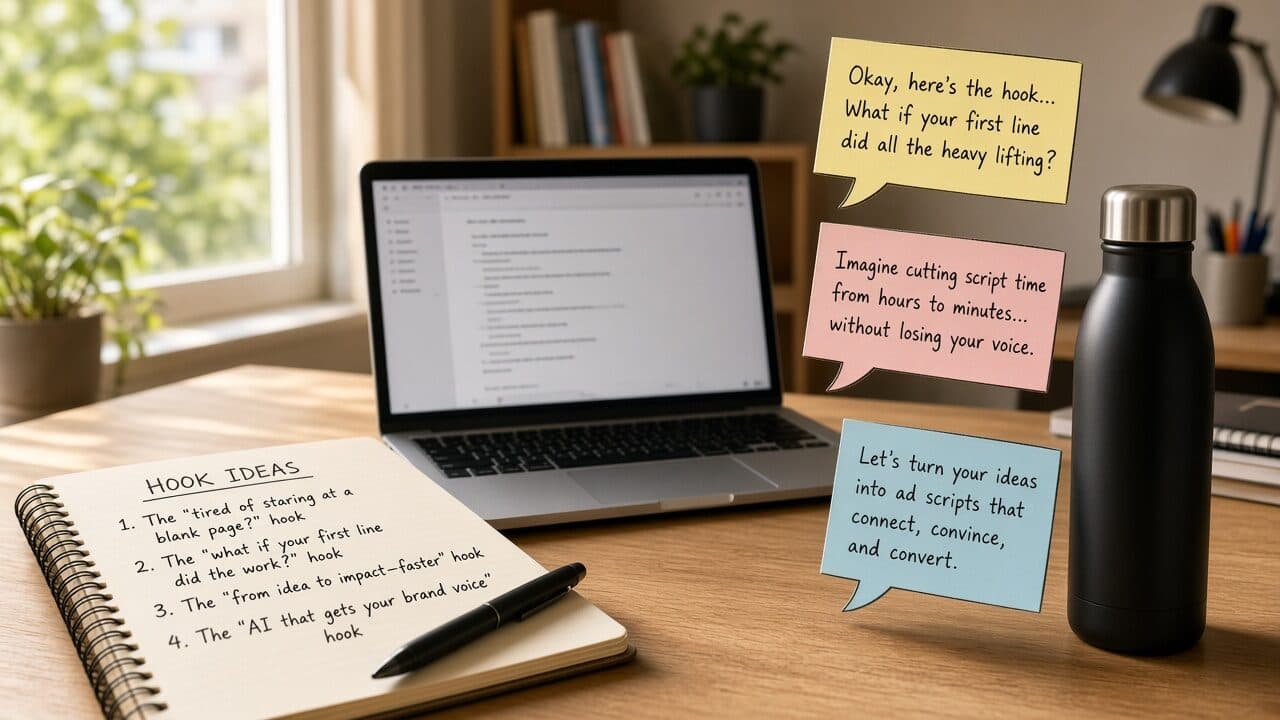
- Variation: write three hooks for every body before you record.
Turning scripts into tests
A good script is a hypothesis, not a finished product. Treat each one as an experiment: one hook, one angle, one offer, compared against a control.
If scripting volume is the bottleneck, VELO Shorts can take a product page, draft a UGC-style script and render it as a vertical video, so you can edit the words with the rules above and test several hooks side by side. The tool speeds up the draft; the editing judgment and the claim discipline are still yours, and they are what make the ads worth watching. If you are starting from a single image, here is how to turn a product photo into video ads.
FAQ
How long should a product video ad script be?
For most paid social placements, 15–30 seconds works well, which is roughly 40–80 spoken words. Use the 3-beat framework for under 20 seconds and the 5-beat framework for 25–45 seconds. Longer is fine only if each second earns attention.
How do I make an AI-written script sound human?
Give the model specifics (the viewer, the problem, real product facts, a limitation), then edit by reading it aloud. Use short sentences and contractions, cut superlatives, and replace abstract phrases with concrete details. Verify all claims before recording.
What is the best hook for a TikTok ad script?
There is no universal best. Hooks that name a specific, recognizable problem or make a concrete claim usually beat generic openers. Write at least three hook variants per script and let testing decide which fits your audience.
Can I use the same script for TikTok and Meta?
Often yes, with small changes. Both favor vertical video and fast hooks, but the tone on TikTok tends to be more casual and the pace faster. Check safe zones and platform policies for each, and adjust captions and call-to-action wording to fit.
How do I avoid risky claims in ad scripts?
Only state what you can substantiate, avoid guaranteed outcomes and medical or income claims, don’t invent testimonials, and review the platform’s current policy for your product category. Keep a record of the source behind each claim.